


Online Personal Trainer: Complete Guide to Virtual Fitness Coaching
- dillonrmurrayKLyc8
- Aug 7
- 7 min read

An online personal trainer is a certified fitness professional who provides customized workout plans, coaching, progress tracking, and accountability remotely through apps, video calls, or messaging. Online coaching offers flexibility, convenience, and personalized guidance without requiring in-person sessions. For anyone comparing coaching options in 2026, working with an online personal trainer has become one of the most practical ways to build strength, lose fat, and stay consistent without being tied to a gym schedule.
This guide breaks down how virtual fitness coaching works, who benefits most, what it costs, and how to choose a qualified coach—so you can decide with confidence.
What Is an Online Personal Trainer?
An online personal trainer is a certified coach who designs and manages your fitness program remotely. Instead of meeting you in a gym, they communicate through a coaching app, email, video calls, or text, and they adjust your training and nutrition guidance based on your progress.
Most online fitness coaches hold recognized certifications from organizations such as the American Council on Exercise (ACE), the National Academy of Sports Medicine (NASM), or bodies aligned with American College of Sports Medicine (ACSM) guidelines. This credentialing matters because it signals the coach understands exercise science, safe programming, and injury prevention — not just workout trends.
A typical online personal trainer relationship includes:
A structured workout programming plan tailored to your goals
Ongoing exercise technique feedback via video check-ins
Goal tracking and periodic reassessment
General nutrition and lifestyle guidance (not medical or clinical advice)
Regular communication for accountability

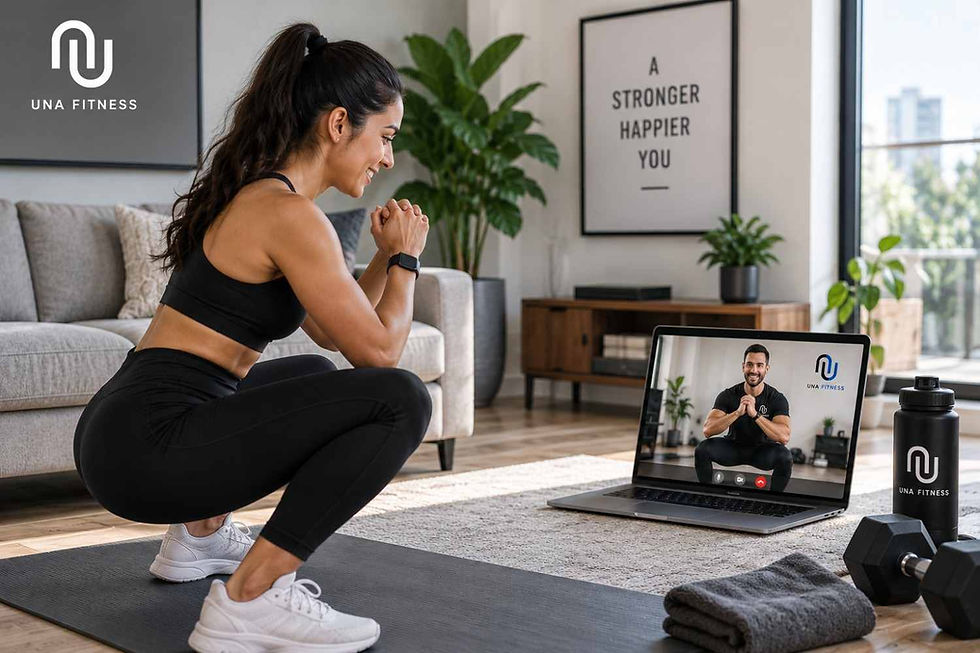
Online personal trainer coaching a client through a video call workout session
Online Personal Trainer vs. Fitness App
It's worth distinguishing a real online personal trainer from a generic workout app. An app gives you pre-built routines with no human feedback. A virtual personal trainer actually reviews your form, adapts your plan when something isn't working, and holds you accountable—which is the main reason coached clients tend to stay more consistent than app-only users.
How Does an Online Personal Trainer Work?
Working with an online fitness coach usually follows a simple, repeatable process:
Initial fitness assessment – You share your goals, training history, injuries, equipment access, and schedule.
Custom program design – The coach builds a plan around strength training, resistance training, mobility, and cardio based on your fitness level.
Delivery through an app or platform – Workouts, videos, and instructions are sent through a coaching app, spreadsheet, or PDF.
Check-ins and feedback – You log workouts, submit form-check videos, or report how sessions felt.
Progress tracking and adjustments – Your online strength coach reviews data (weights lifted, body composition, energy levels) and adjusts progressive overload week to week.
Ongoing communication – Messaging or scheduled calls keep you accountable between sessions.
This structure is why online coaching works well even for people who've never trained with a professional before — the process is built around consistency and gradual progression rather than one-off sessions.
Benefits of Hiring an Online Personal Trainer
Personalized Plans
Your program is built around your actual goals, equipment, and limitations rather than a generic template.
Flexibility and Convenience
An online workout coach lets you train on your own schedule — early morning, during a lunch break, or late at night — without commuting to a gym.
Lower Cost Than In-Person Training
Because there's no facility overhead, an online workout plan from a coach is often more affordable than comparable in-person sessions.
Built-In Accountability
Regular check-ins with a remote personal trainer create structure that's hard to replicate when training alone.
Continuous Progress Tracking
Coaches log strength gains, body composition trends, and habit consistency, adjusting your plan as you improve.
Access to Specialized Coaches
You're not limited to trainers near your zip code — you can choose an online strength coach or online weight loss coach who specializes in exactly what you need.
Time Savings
No travel time means more consistency, especially for people with unpredictable schedules.
Who Should Hire an Online Personal Trainer?
Online coaching works well across a wide range of situations:
Beginners who need structured guidance and confidence with exercise technique
Busy professionals who need flexible scheduling around work
Parents balancing family responsibilities with fitness goals
Frequent travelers who need adaptable, equipment-flexible programming
Weight loss clients who want structured programming plus habit coaching
Muscle-gain clients focused on progressive overload and strength training
Home gym users who want a plan built specifically around their equipment
If you fall into any of these categories, a personal trainer online can offer the same core benefits as in-person coaching — personalization, structure, and accountability — with far more flexibility.
Online Personal Trainer vs. In-Person Personal Trainer
Factor | Online Personal Trainer | In-Person Personal Trainer |
Cost | Generally lower, no facility overhead | Higher, includes gym/studio costs |
Convenience | Train anywhere, anytime | Requires travel to a fixed location |
Flexibility | Highly flexible scheduling | Limited to trainer's available slots |
Accountability | Message/app-based check-ins | Immediate, in-person accountability |
Equipment | Adapts to home gym or minimal equipment | Full gym equipment access |
Communication | Video, messaging, app-based | Face-to-face, real-time |
Personalization | Data-driven, adjusted remotely | Real-time hands-on correction |
Best For | Self-motivated clients, busy schedules | Clients needing hands-on supervision |
Neither option is universally ""better"—the right choice depends on your budget, learning style, and how much hands-on correction you personally need.
What to Look for Before Hiring an Online Personal Trainer
Choosing the right online fitness trainer matters more than choosing quickly. Evaluate these factors:
Certifications – Look for ACE, NASM, ISSA, or equivalent accredited credentials.
Experience – Ask about experience with clients who share your goals or limitations.
Reviews and testimonials – Genuine client results and feedback matter more than marketing claims.
Communication style – Confirm how often you'll hear from your coach and through what platform.
Goal-setting process – A good coach sets realistic, measurable milestones, not vague promises.
Progress tracking methods – Ask whether they track strength, habits, or only body weight.
Nutrition guidance approach – Coaches without registered dietitian credentials should offer general habit-based guidance, not medical nutrition therapy.
Coaching platform/app – Test whether the app is easy to use for logging workouts and messaging.
Red Flags to Watch For
Promises of rapid, dramatic results
No verifiable certification
No structured check-in process
Pressure tactics or long-term contracts with no trial period
How Much Does an Online Personal Trainer Cost?
Pricing for an online personal training program varies based on several factors:
Coach experience and specialization – More experienced or specialized coaches typically charge more.
Level of support – Text-only coaching costs less than plans with weekly video calls.
Program length and commitment – Monthly plans versus longer-term packages affect per-month pricing.
Group vs. one-on-one coaching – Semi-private or group coaching is generally more affordable than fully individualized coaching.
Added services – Nutrition coaching, habit tracking, or wearable data integration can increase cost.
As a general guide, many online coaching programs in the U.S. market fall in a budget-friendly to mid-range monthly range, with premium one-on-one coaching priced higher. Always confirm exact pricing directly with a coach, since rates vary widely by niche and experience level.
Common Mistakes When Choosing an Online Coach
Choosing based on price alone, ignoring qualifications
Not checking certifications before signing up
Expecting results without consistent effort
Ignoring the coach's communication style and responsiveness
Skipping the initial fitness assessment or being vague about goals
Not asking how progress will actually be tracked
Tips to Get Better Results With Online Coaching
Be consistent with check-ins and honest progress updates
Film workouts for technique feedback whenever possible
Track more than just weight—strength, energy, and habits matter too
Communicate early if a plan isn't working, rather than pushing through silently
Invest in a few pieces of home equipment (bands, dumbbells) if budget allows
Use wearable fitness devices to support progress tracking between check-ins
Prioritize recovery and sleep alongside training and protein intake
Final Verdict
An online personal trainer is a legitimate, effective alternative to in-person coaching for most people—particularly beginners, busy professionals, and anyone who values flexibility. The model works best for self-motivated clients who can film their own form checks and communicate consistently with their coach. If you need constant hands-on correction or supervision, in-person training may still be worth the added cost. For everyone else, a qualified online personal trainer offers a practical, affordable path to real, sustainable fitness progress.
Frequently Asked Questions
What is an online personal trainer? An online personal trainer is a certified fitness coach who builds and manages your workout program remotely through apps, video calls, or messaging, rather than in-person sessions.
Is an online personal trainer worth it?
For most self-motivated clients, yes — online coaching offers personalized programming and accountability at a lower cost than in-person training, provided the coach is properly certified.
How much does an online personal trainer cost?
Costs vary by coach experience, support level, and program length, generally ranging from budget-friendly to premium tiers depending on how personalized the coaching is.
Can beginners use an online personal trainer?
Yes. A qualified online coach can guide beginners through proper technique using video feedback and progressively structured programming.
Is online coaching effective?
Online coaching can be highly effective when clients stay consistent with check-ins, follow programming as directed, and communicate openly about progress or setbacks.
How does online personal training work?
It typically starts with an assessment, followed by a custom program delivered through an app, with regular check-ins and adjustments based on your progress.
Can I lose weight with an online personal trainer?
Yes, many clients use online coaching for weight loss through structured training plans combined with general nutrition and habit guidance.
Can beginners hire an online coach?
Yes, many online trainers specialize in working with beginners and focus heavily on teaching correct exercise technique from the start.
What equipment do I need for online personal training?
This depends on your coach and goals — some programs work with bodyweight only, while others use a home gym setup with dumbbells, bands, or a barbell.
How often should I train with an online coach?
Frequency depends on your goals and schedule, but most programs range from 3–5 sessions per week, adjusted to your recovery and lifestyle.
How do online trainers track progress?
Most coaches track strength gains, workout logs, body composition trends, and habit consistency through an app or shared tracking sheet.
Are online workout plans customized?
Yes, reputable online trainers build plans around your specific goals, equipment, injury history, and schedule rather than using generic templates.
What's the difference between online and in-person personal training?
Online training offers more flexibility and lower cost, while in-person training provides real-time physical correction and supervision.
How do I choose the best online personal trainer?
Look for verified certifications, relevant experience, clear communication, a structured check-in process, and genuine client reviews before committing.


Comments